|
Getting your Trinity Audio player ready...
|
Most water filter jugs are bought for one of two reasons: improving the taste of tap water or reducing limescale. The Klar Fluoride Water Filter Pitcher 3.5L is aimed at people looking for something considerably more comprehensive.
Rather than concentrating primarily on chlorine and hardness, Klar has designed its 3.5-litre pitcher around multi-stage filtration that specifically includes fluoride reduction. The company states that the filter reduces up to 95% of fluoride in tap and bottled water, while also targeting substances including chlorine, heavy metals, microplastics, pharmaceuticals and PFAS, often referred to as forever chemicals.
There is another interesting difference. Instead of simply removing substances from the water and leaving it there, the Klar filtration system remineralises the water after filtration, adding zinc, selenium, trace potassium and magnesium. The result is water that Klar describes as alkaline mineral water rather than completely demineralised water.
At £46.99, however, this is significantly more expensive than an entry-level BRITA jug. Replacement Klar cartridges currently cost £13.89 each, with the manufacturer recommending replacement after 60 days or 350 litres, whichever comes first.
That immediately raises the question: are you actually getting enough extra filtration and convenience to justify paying more?
After living with the Klar pitcher as an everyday kitchen water filter, its biggest strength becomes clear quite quickly. This is not trying to be the cheapest way to make tap water taste nicer. It is aimed at buyers who have already decided they want more extensive filtration from a simple countertop or fridge-friendly jug.
There is also an important point worth addressing before getting into the review. Fluoride removal should be treated as a product capability rather than automatically being presented as a health benefit. UK public health authorities continue to support regulated water fluoridation for reducing tooth decay, and the Drinking Water Inspectorate limits fluoride in public supplies to no more than 1.5mg per litre. The UK Health Security Agency’s 2026 monitoring report found benefits for reducing childhood tooth decay and no convincing evidence of the non-dental harms it assessed.
The Klar therefore makes most sense for people who have personally chosen to reduce fluoride or who want the wider filtration capabilities offered by the system, rather than because everyone needs to remove fluoride from their drinking water.
With that distinction made, there is plenty about the Klar Fluoride Water Filter Pitcher 3.5L that impressed us.
Quick Verdict
| Category | Verdict |
|---|---|
| Overall Rating | 4.5 out of 5 |
| Best For | Households wanting more comprehensive filtration than a standard water filter jug |
| Short Summary | A large, easy-to-use filtration pitcher with a strong focus on fluoride reduction, long filter life and remineralisation |
| Main Pros | Up to 95% fluoride reduction claimed, 3.5L capacity, 350-litre filter life, fast filtration, BPA and phthalate-free construction, remineralisation |
| Main Cons | Higher initial price than mainstream filter jugs, replacement cartridges are brand-specific, not dishwasher recommended, larger size takes up more fridge space |
| Quick Buying Recommendation | Recommended if fluoride reduction and broader filtration are priorities. Less compelling if you only want inexpensive better-tasting tap water |
The Klar occupies an interesting middle ground between a basic water filter jug and considerably more expensive under-sink or reverse osmosis systems.
For renters in particular, that could make it attractive. There is no plumbing, installation or permanent modification required. Fill the reservoir, let the filter do its job and pour.
Product Overview Table
| Product Detail | Information |
| Product Name | Klar Fluoride Water Filter Pitcher 3.5L |
| Brand | Klar Water |
| Product Type | Multi-stage water filtration pitcher |
| Capacity | 3.5 litres |
| Key Features | Up to 95% fluoride reduction, microplastic filtration, remineralisation, alkaline water, fast filtration, digital filter timer |
| Main Purpose | Filtering tap or bottled water while reducing fluoride and a wider range of unwanted substances |
| Price | £46.99 at time of review |
| Replacement Filter Price | £13.89 at time of review |
| Filter Lifespan | Up to 60 days or 350 litres |
| Materials | Type 5 plastic construction, BPA and phthalate free |
| Added Minerals | Zinc, selenium, trace potassium and magnesium |
| Best For | Families, regular filtered-water drinkers and people specifically searching for a fluoride water filter jug |
| Colour or Variants | Standard Klar pitcher design |
Klar states that the pitcher uses a seven-stage filtration system and has been independently tested in the UK and US. The company also says the jug and filter material have undergone testing by SGS laboratories.
Design & Build Quality
The first thing you notice about the Klar is its size.
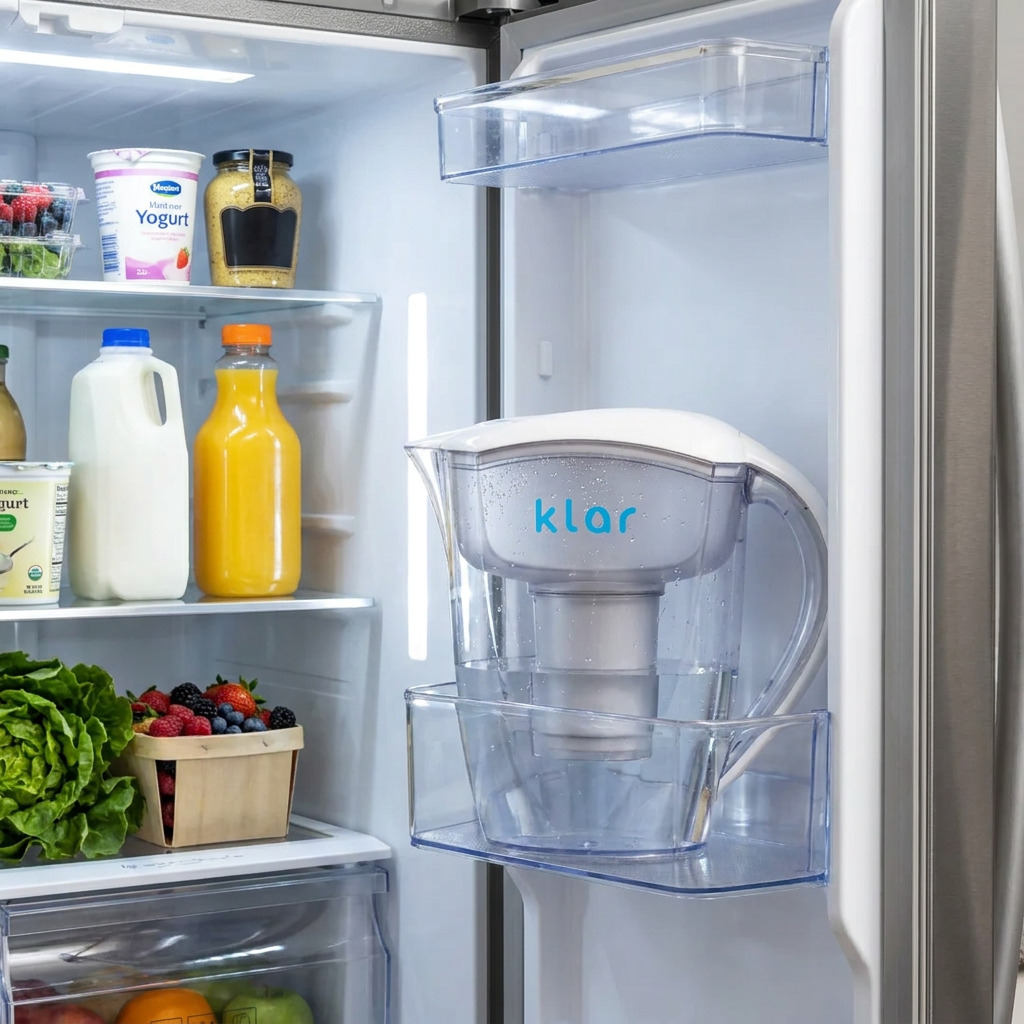
A 3.5-litre pitcher is noticeably more substantial than many of the compact filter jugs designed primarily to slot into a refrigerator door.
That extra capacity is both a strength and a minor inconvenience.
If you have a family constantly filling glasses, water bottles and kettles, the larger reservoir makes complete sense. You spend less time repeatedly returning to the tap.
If you live alone and have a small fridge, however, the Klar can feel bigger than necessary.
The overall design is clean and functional rather than particularly luxurious. It is clearly a water filtration product, but it does not look out of place on a kitchen worktop or dining table.
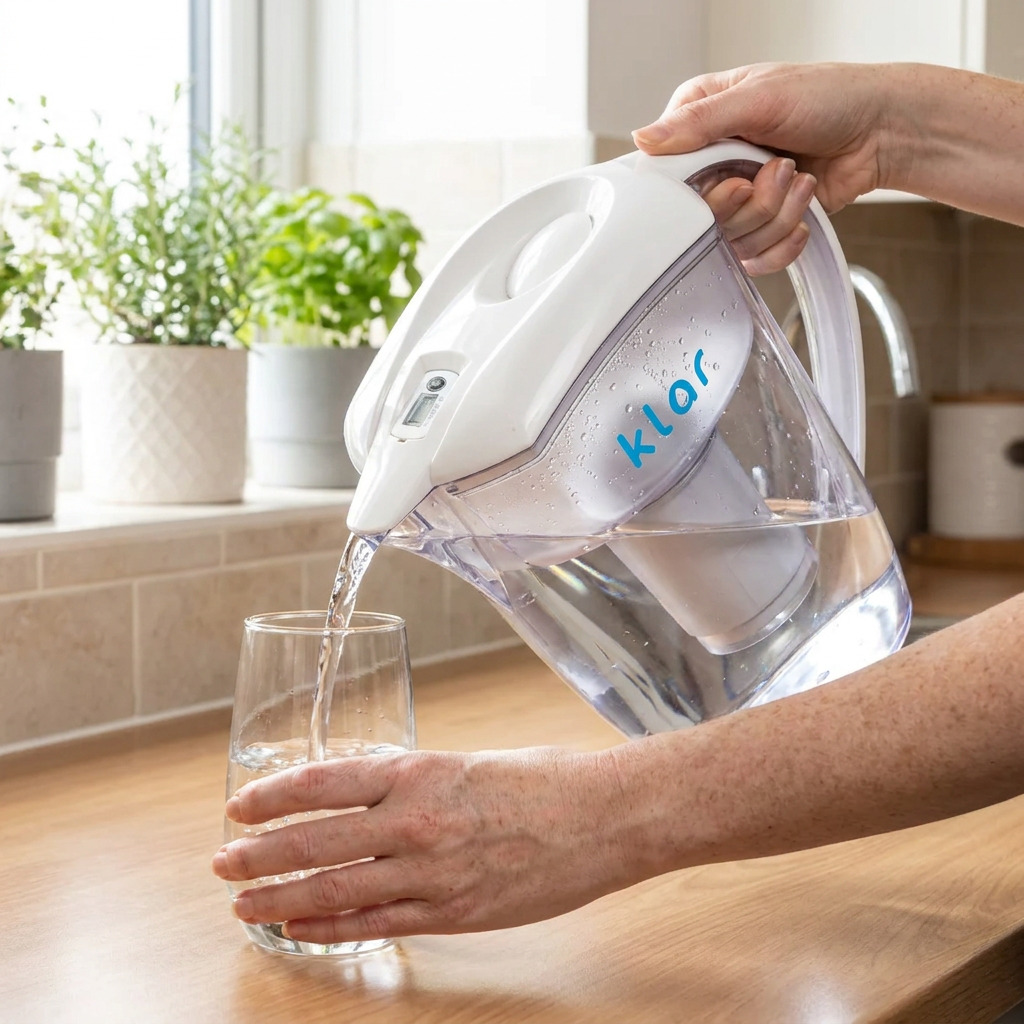
The transparent body makes it easy to see how much filtered water remains, while the handle feels appropriately substantial for a pitcher capable of holding several litres.
When full, this is naturally not a particularly light jug.
That is worth considering for anyone with reduced hand or wrist strength. Three and a half litres of water alone weighs approximately 3.5kg before accounting for the pitcher itself.
For most adults, pouring is perfectly manageable, but the larger capacity inevitably creates more weight than a smaller 2-litre jug.
Klar uses Type 5 plastic and states that the pitcher is both BPA and phthalate free. The company describes the construction as durable and intended for years of use.
Nothing about the jug feels particularly fragile during normal handling.
One feature we particularly like is the automatic refill flap. It makes topping up the pitcher straightforward without requiring you to completely dismantle the lid every time.
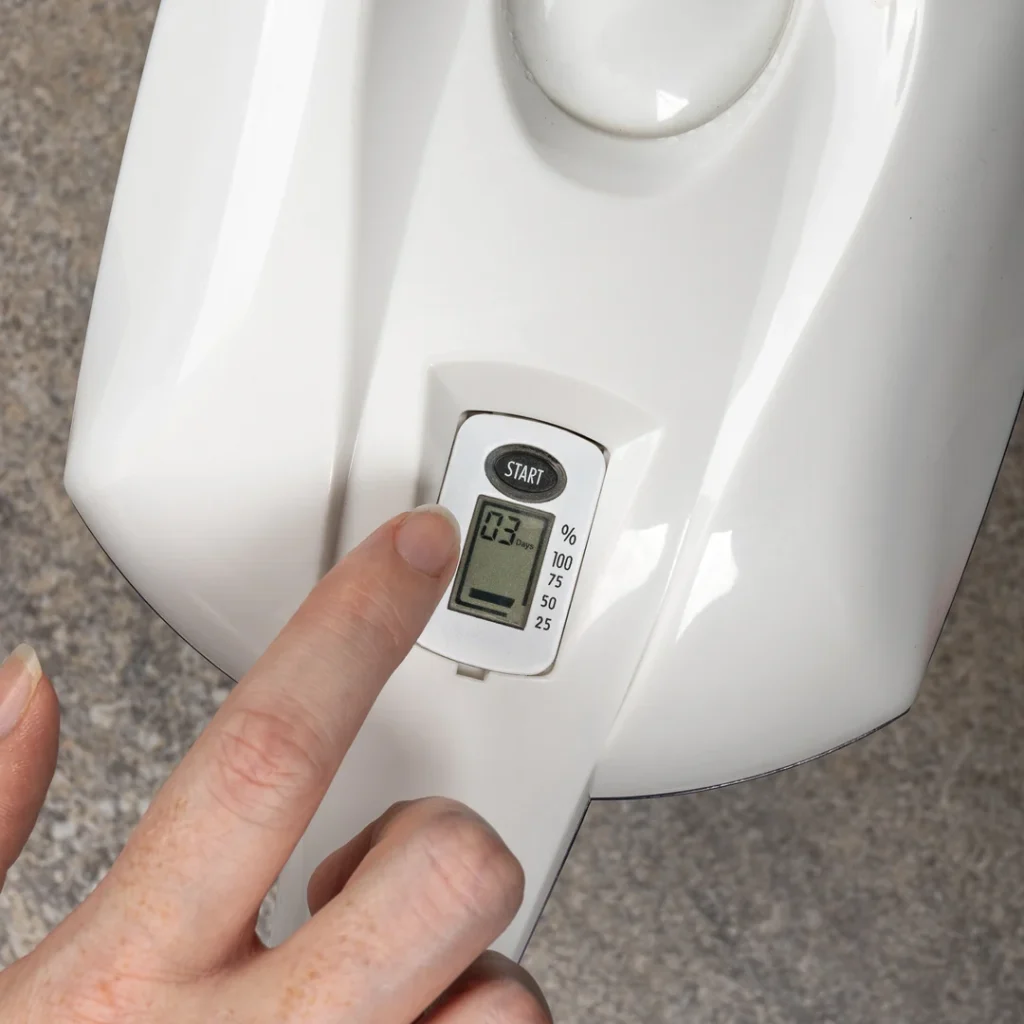
There is also a 60-day digital countdown timer to help remind you when the cartridge is due for replacement.
That sounds like a small feature, but it is useful.
Filters tend to be replaced either far too early because nobody remembers when they were installed, or several months too late because everyone assumes somebody else changed it.
There is one design limitation worth knowing about. Klar currently advises washing the pitcher by hand rather than putting it in the dishwasher.
That is not difficult, but BRITA buyers accustomed to dishwasher-safe jug components may see it as a minor downgrade in convenience.
Overall, build quality feels appropriate for the price. You are not paying £46.99 because it uses exotic materials. The value sits predominantly inside the filtration system.
Features & Performance
Seven-stage filtration
Klar describes its system as seven-stage filtration designed to tackle a broader range of substances than many everyday water pitchers.
The manufacturer’s current claims include reductions in fluoride, chlorine, heavy metals, microplastics, pharmaceuticals and hormones, along with PFAS compounds.
The standout claim remains fluoride.
Klar states that independent testing found the filter can reduce up to 95% of fluoride from tap and bottled water.
That immediately separates it from standard BRITA filters, where the focus is primarily on improving taste, reducing chlorine, certain trace impurities, metals and limescale. BRITA’s current MAXTRA PRO system does not position fluoride reduction as one of its headline capabilities.
For buyers specifically searching for the best fluoride water filter pitcher in the UK, that distinction matters.
Remineralisation
One of the more unusual elements of the Klar system happens after filtration.
The pitcher reintroduces zinc, selenium, trace potassium and magnesium using mineral media. Klar says this also moves the resulting water towards an alkaline pH.
This is important when comparing Klar with filtration systems designed to strip dissolved solids much more aggressively.
Klar is not attempting to produce zero-TDS water.
In fact, the company specifically explains that a TDS meter may still show readings around 190 to 250 because minerals are deliberately added back after filtration.
That initially sounds counterintuitive if you associate lower TDS numbers with better filtration, but total dissolved solids alone do not tell you exactly which substances remain in the water.
In everyday terms, Klar is trying to produce filtered mineral water rather than virtually deionised water.
Taste
Taste is naturally subjective, but this was one of the easiest improvements to appreciate in normal use.
Freshly filtered Klar water tastes clean and neutral without feeling completely flat.
If your tap water has an obvious chlorine note, filtration makes a noticeable difference, particularly when the water has been chilled.
That difference becomes even more obvious when you start filling reusable bottles from the Klar rather than buying bottled water.
Tea and coffee also benefit from water with less obvious chlorine taste, although buyers in very hard-water areas should understand that Klar is not primarily a water-softening jug.
The company acknowledges that because minerals are reintroduced after filtration, it only provides some reduction in limescale rather than completely eliminating it.
If your main problem is a kettle that develops scale incredibly quickly, a specialist hard-water filter may therefore be a better choice.
Filtration speed
One frustration with heavily filtered water pitchers can be waiting endlessly while water slowly works through the cartridge.
The Klar performs well here.
Filling the reservoir and allowing the water to pass through does not feel like a chore, particularly once the filter has been properly prepared.
It is quick enough that topping the jug up after pouring several glasses becomes part of the normal kitchen routine rather than something you have to plan around.
The large capacity helps too.
You can fill it, put it aside and have enough filtered water available for several drinks rather than immediately needing another cycle.
Filter lifespan
Each cartridge is rated for 350 litres or approximately 60 days.
Klar bases that roughly on filtering five litres per day.
That is significantly more water per cartridge than BRITA’s current MAXTRA PRO cartridges, which are rated for up to 150 litres.
Actual value naturally depends on how much water your household uses.
A couple regularly drinking filtered water, filling bottles and making hot drinks can easily make good use of the 350-litre allowance.
A single person filtering only one or two glasses each day may hit the recommended two-month replacement period long before reaching 350 litres.
Initial setup
There is a little preparation required when fitting a new cartridge.
Klar recommends discarding the first two pitchers of filtered water when installing a fresh filter.
You may initially see small black particles in the water. These are activated carbon particles that can become loose during transport, which is why flushing the cartridge before normal drinking use matters.
It is not difficult, but it is something buyers need to know.
Once that first setup is complete, everyday operation is exceptionally simple.
Real-World Experience
A water filter pitcher is one of those products where the novelty disappears quickly.
That is actually a useful test.
After several days, you stop thinking about the filter technology and simply start judging whether using the jug is more convenient than turning on the tap.
With the Klar, it was.
The 3.5-litre capacity proved particularly useful first thing in the morning. There was enough filtered water available for drinking, filling a reusable bottle and making coffee without immediately having to refill the pitcher.
Keeping the Klar chilled in the fridge also noticeably encouraged us to drink more plain water.
That sounds trivial, but cold filtered water sitting ready to pour is considerably more appealing than reaching for bottled drinks or simply forgetting to drink altogether.
The flavour became one of the strongest reasons to continue using it.
We would not describe the change as dramatic if your local tap water already tastes good. The difference is much clearer in areas where chlorine or mineral flavours are obvious.
Once you become used to the filtered water, however, going back to an unfiltered glass makes those differences easier to notice.
The size also generated our biggest practical criticism.
When completely full, the Klar is heavy.
Rather than continually filling it to maximum capacity, we found ourselves sometimes adding less water when we knew only one or two people would be using it.
Fridge placement also matters.
Although the jug can be stored chilled, its 3.5-litre size naturally demands more space than compact fridge-door models.
There is no requirement to refrigerate it. Klar says the replacement filter incorporates an antibacterial inhibitor and therefore the pitcher does not need to be kept in the fridge.
That makes keeping it on the kitchen worktop a perfectly reasonable option if fridge space is limited.
Cleaning is straightforward but manual.
Klar recommends cleaning the jug whenever the cartridge is changed, roughly every two months, and currently advises against dishwasher cleaning.
We would prefer dishwasher compatibility simply because anything that makes long-term maintenance easier is welcome.
Another thing we appreciated over time was the digital timer.
With so many household products demanding replacement filters, cleaning cycles and maintenance, having a straightforward reminder avoids relying on memory.
The experience ultimately feels pleasantly uneventful.
Fill it. Wait for filtration. Pour. Refill it when necessary.
That is exactly what a good water pitcher should be.
Pros & Cons Table
| Pros | Cons |
| Filters up to 95% of fluoride according to independent testing cited by Klar | £46.99 upfront price is high compared with basic filter jugs |
| 3.5-litre capacity works well for households | Large pitcher requires more fridge space |
| 350-litre filter capacity | Heavy when completely full |
| 60-day replacement interval is easy to manage | Replacement cartridges are specific to Klar |
| Fast everyday filtration | Hand washing recommended rather than dishwasher cleaning |
| Reduces chlorine and various other substances | Does not completely eliminate limescale |
| Targets microplastics and several wider contaminants | Fluoride reduction is unnecessary for buyers who actively want fluoridated drinking water |
| Remineralises after filtration | First two pitchers should be discarded when fitting a new filter |
| BPA and phthalate free | Higher ongoing cost than some mainstream systems |
| Digital filter countdown | No integrated water quality meter |
| No plumbing or installation required | 3.5L may be excessive for light individual use |
Who Should Buy This?
The Klar Fluoride Water Filter Pitcher 3.5L is best suited to buyers who have already moved beyond simply asking whether filtered water tastes better.
Its strongest audience is anyone specifically searching for a fluoride-removing water filter pitcher without wanting to install an under-sink system.
It also suits renters.
There is no plumbing modification, drilling or permanent installation required, so you can take the whole system with you when moving house.
Families and couples are likely to benefit more from the 3.5-litre capacity than single-person households.
It is also worth considering if you currently buy large quantities of bottled water because you dislike the taste of your local tap supply. Switching to a reusable filtration system could reduce the number of plastic bottles being purchased and carried home.
Who should skip it?
If your only concern is chlorine taste, the Klar is probably more filter than you need.
A cheaper BRITA jug can improve drinking-water taste and reduce limescale-related substances at a significantly lower entry price.
Similarly, if your primary concern is extremely hard water and kettle scale, Klar itself acknowledges that its remineralisation process means some mineral residue can remain after boiling.
Parents considering fluoride removal for children’s drinking water should also understand that UK public health guidance supports fluoridated water as a measure to reduce tooth decay. Removing fluoride should therefore be an informed personal choice rather than something assumed to be automatically healthier.
As a gift, the Klar is more appealing than it initially sounds.
For somebody setting up a new home, trying to reduce bottled-water use or already interested in water filtration, it is a genuinely useful household present.
Alternatives & Comparisons
Klar vs BRITA
BRITA is the obvious comparison because it dominates the UK water filter jug market.
A BRITA Marella or Aluna is cheaper, replacement filters are widely available and the products are extremely easy to find in supermarkets and online.
BRITA’s MAXTRA PRO filtration targets chlorine, substances affecting taste, certain trace impurities, metals such as lead and copper and water hardness.
The Klar is more specialised.
Its key advantage is the claimed reduction of up to 95% of fluoride alongside its wider multi-stage filtration and remineralisation.
Klar filters are also rated for up to 350 litres compared with up to 150 litres for a BRITA MAXTRA PRO cartridge.
BRITA wins for price, availability and established ecosystem.
Klar wins if fluoride reduction is one of your main buying criteria.
Klar vs ZeroWater
ZeroWater takes a very different approach.
Its 2.8-litre UK pitcher uses five-stage dual ion-exchange filtration designed to remove virtually all total dissolved solids and includes a TDS meter so users can directly monitor dissolved-solid readings. Its current UK product information highlights reductions in contaminants including lead, PFAS, chromium and mercury.
Klar deliberately does not aim for a zero TDS result.
Instead, it filters the water and then adds selected minerals back.
This makes the comparison largely philosophical.
If you specifically want extremely low dissolved-solids readings and like having a meter to verify performance, ZeroWater is attractive.
If you prefer filtered water that has been remineralised and specifically want Klar’s independently tested fluoride reduction claim, Klar makes more sense.
Filter life can also vary dramatically with ZeroWater depending on the starting quality and TDS level of your local water, whereas Klar gives buyers the clearer 350-litre or 60-day replacement schedule.
Klar vs an under-sink filtration system
An under-sink system is the premium alternative.
The biggest advantage is convenience. Turn on a dedicated tap and filtered water is immediately available without filling a pitcher.
The disadvantages are cost, installation, replacement cartridges and the fact that renters may not be able to fit one.
Klar gives you much of the convenience of advanced filtration without committing to permanent plumbing.
For many households, that makes a pitcher the easier place to start.
Is It Worth The Money?
At £46.99, the Klar Fluoride Water Filter Pitcher 3.5L is not cheap.
Look at it purely as a plastic water jug and the price appears difficult to justify.
Look at the filtration system, and the argument becomes considerably stronger.
Each £13.89 filter is rated for 350 litres.
If you achieve the full rated volume, that works out at just under 4p per litre for the replacement cartridge itself.
That compares favourably with repeatedly purchasing bottled water, particularly before you account for the inconvenience of carrying bottles home and disposing of the packaging.
The initial pitcher price is therefore easier to view as an investment in the filtration platform.
There are cheaper alternatives.
If you do not care about fluoride reduction, BRITA makes more financial sense for many households.
If fluoride filtration is specifically why you are shopping, however, the Klar has a much stronger reason to justify its premium.
We also like that the cartridges last up to 60 days or 350 litres. The replacement schedule does not feel excessive and Klar operates a recycling option for customers whose local council cannot accept the used filters. Customers can collect six and contact Klar for a return recycling label.
Overall, we would call it good value rather than cheap.
The difference matters.
This is available on Amazon.
Final Verdict
The Klar Fluoride Water Filter Pitcher 3.5L knows exactly what type of buyer it is targeting.
If you simply want tap water to taste slightly better, there are cheaper options everywhere.
If you specifically want a water filter pitcher capable of substantially reducing fluoride while also targeting a wider selection of unwanted substances, Klar becomes considerably more interesting.
The claimed 95% fluoride reduction is the headline feature, but it was actually the everyday usability that made the pitcher easy to recommend.
The filtration is quick.
The 3.5-litre capacity is genuinely useful.
The water tastes clean.
The 350-litre cartridge life is competitive.
The digital timer removes some of the guesswork from maintenance.
And the remineralisation system provides a meaningful point of difference from filters designed simply to strip dissolved solids as aggressively as possible.
There are areas we would change.
At £44.99, the initial investment will immediately rule it out for some buyers.
The full jug is heavy, the size demands fridge space and we would prefer dishwasher-safe components.
It is also important not to present fluoride removal as an automatic health upgrade. Current UK public health guidance supports regulated water fluoridation for dental health. The real advantage of Klar is giving consumers who have chosen to reduce fluoride an accessible way to do so without fitting a permanent filtration system.
For the right buyer, that combination of specialised filtration and everyday simplicity works extremely well.
After the initial setup, the Klar disappears into the normal rhythm of the kitchen, and that is probably the biggest compliment we can give it.
It does a relatively complicated job without feeling like a complicated product.
For households looking for one of the more comprehensive fluoride water filter pitchers available in the UK, the Klar Fluoride Water Filter Pitcher 3.5L is well worth considering.
Overall Rating: 4.5 out of 5.
FAQs
Does the Klar Water Filter Pitcher remove fluoride?
Klar states that its 3.5L water filter pitcher reduces up to 95% of fluoride from tap and bottled water. The company says this performance has been independently tested in the UK and US.
How long does a Klar water filter last?
Each Klar replacement cartridge is rated for up to 60 days or 350 litres of filtered water, whichever is reached first. Klar estimates this at roughly five litres of filtration per day.
How much do Klar replacement filters cost?
At the time of review, an individual replacement filter costs £12.89 directly from Klar Water. Prices can change, so it is worth checking the latest price before calculating long-term running costs.
Does the Klar water filter remove chlorine?
Yes. Klar states that activated carbon within the filter reduces chlorine along with other substances that can affect the taste and smell of tap water.
Does the Klar pitcher remove microplastics?
Klar lists microplastic filtration among the capabilities of its filtration system. It also markets the pitcher for reducing fluoride, heavy metals and a selection of other unwanted substances.
Does Klar remove limescale?
Not completely. Klar explains that because minerals are reintroduced after filtration, users may still see some mineral residue after boiling. If limescale is your main concern, a filter specifically designed for very hard water could be more appropriate.
Does the Klar filter make alkaline water?
Klar states that its filtration and remineralisation system shifts the water towards an alkaline pH, with the company describing an output around pH 8 to 9 depending on the starting water.
Can the Klar water filter pitcher go in the dishwasher?
Klar currently recommends washing the pitcher by hand rather than putting it in the dishwasher. The company advises cleaning the jug each time the cartridge is replaced, which is normally every two months.
Do I need to keep the Klar pitcher in the fridge?
No. Klar says the cartridge contains an antibacterial inhibitor, so the pitcher does not need to be stored in the refrigerator. You can still refrigerate it if you prefer chilled drinking water.
Is the Klar Fluoride Water Filter Pitcher 3.5L worth buying?
Yes, if you specifically want fluoride reduction and broader filtration from a straightforward pitcher rather than installing a permanent filtration system. Its £44.99 price is considerably higher than a basic filter jug, but the 350-litre cartridge capacity, remineralisation and specialised filtration make the premium easier to justify for the right household.